Here’s what most people do when they decide to renovate their house:
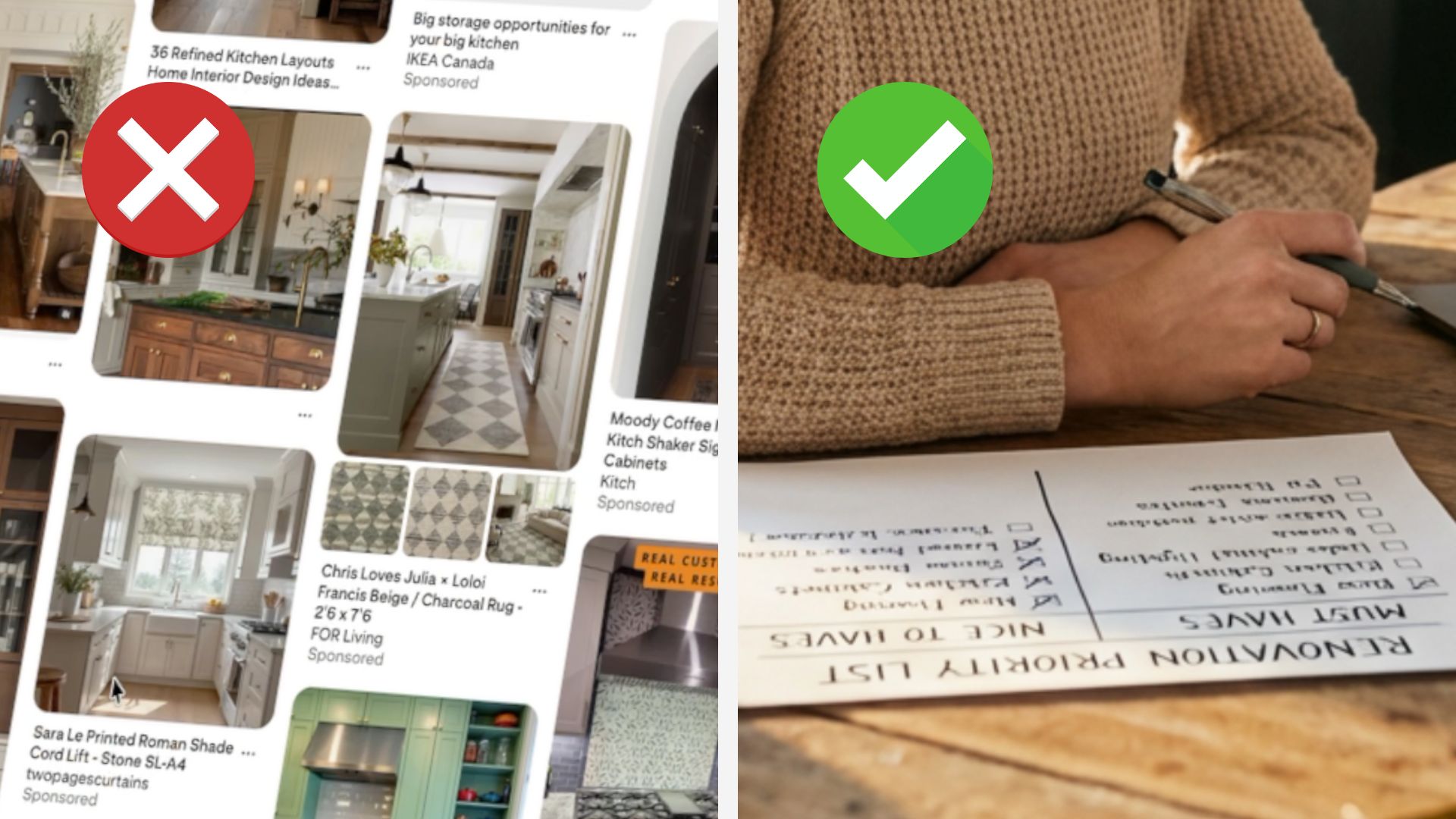
They open Instagram. They start a Pinterest board. They save photos of beautiful kitchens and bathrooms. Then they call a contractor to get a quote.
And that’s the problem right there.
They’ve skipped the single most important step of a good renovation — the step that determines whether your project actually solves your problem or just makes your house look different.
As a Venezuelan-trained architect with 10 years of construction experience across Venezuela, Chile, and Toronto, I can tell you this: the most expensive renovation mistakes happen before any construction starts. They happen in the planning phase that most people skip entirely.
So in this post (and video below), I’m going to show you what that first step actually is — the step architects never skip, but homeowners almost always do.
What Most People Do Wrong
Let’s be honest about the typical renovation journey:
Someone decides they want to renovate. They spend weeks scrolling through design content. They fall in love with a specific aesthetic. They call contractors, get quotes, pick one, and start construction.
Halfway through the project, they realize:
- They’re solving the wrong problem
- The budget is blown
- What they’re building doesn’t actually work for how they live
- They’re making expensive changes mid-construction because the plan wasn’t clear
And they wonder: how did this happen?
The answer: They skipped step one.
The First Step Architects Never Skip
Before Pinterest. Before contractors. Before any design work at all.
Architects ask one simple question:
“Why are you renovating?”
And no, “I want a new kitchen” isn’t the answer. That’s the what, not the why.
The real question is: What’s not working? What problem are you actually trying to solve?
This sounds obvious. But I promise you, most people never stop to answer this properly. They jump straight to solutions without understanding the problem.
And that’s how you end up spending $80,000 on a beautiful new kitchen that doesn’t actually make your life better because the real problem was something completely different.
Why This Step Matters (And What Happens When You Skip It)
Think of renovation planning like diagnosing a health problem.
If you go to a doctor and say “I want surgery on my knee,” a good doctor doesn’t immediately schedule surgery. They ask: “Why? What’s wrong? What symptoms are you experiencing?”
Because maybe the problem isn’t your knee at all. Maybe it’s your hip, or your posture, or your shoes. And if they operate on your knee without diagnosing the real problem, you’ve just spent a lot of money and time on something that doesn’t help.
Renovations work the same way.
When you skip the “why” and jump straight to “what,” you risk:
- Spending money on the wrong solution
- Creating something beautiful that doesn’t function for your life
- Leaving the real problem unsolved
- Having to do another renovation in a few years when you finally figure out what you actually needed
When you start with “why,” you get:
- Clear direction for your project
- A renovation that actually solves your problem
- Better budget allocation (money goes where it matters)
- Confidence in your decisions
How to Actually Do Step One: Ask Better Questions
So how do you figure out your “why”? You ask yourself better questions.
Not “what do I want?” but “what’s not working?”
The Three Questions to Ask Yourself
1. Why am I doing this renovation?
Be specific. Dig deeper than surface answers.
Surface answer: “I want a new kitchen” Deeper answer: “Our kitchen is too small and we can’t all be in there at the same time”
Surface answer: “I want to finish the basement”
Deeper answer: “We need a home office and the kids need a playroom, but we don’t have space upstairs”
Surface answer: “I want to update our bathroom” Deeper answer: “We have one bathroom for four people and morning routines are chaos”
See the difference? The deeper answer tells you what problem you’re actually solving.
Common real reasons people renovate:
- Need more space for growing family
- Layout doesn’t work for how they live
- Lack of storage causing daily frustration
- Structural or mechanical issues that need fixing
- Home office needed (post-pandemic reality)
- Aging in place considerations
- Preparing to sell
2. How do I actually live in this house?
Not how you wish you lived. Not how Instagram people live. Your actual, real, everyday life.
Be honest:
- Where do you actually spend time?
- Where does stuff pile up?
- What causes frustration every single day?
- What makes your morning routine difficult?
- Where do guests congregate when they visit?
- What spaces do you avoid or never use?
This is uncomfortable because it means admitting that maybe you don’t use your dining room. Maybe you eat at the kitchen counter every single night even though you have a beautiful dining table.
That’s okay. Design for your real life, not your aspirational life.
3. What’s currently broken or not functioning?
Be specific. Don’t just say “the kitchen is bad.”
Instead of: “The kitchen is outdated”
Ask: “What specifically doesn’t work? Not enough counter space? Appliances breaking down? Poor layout? Too dark? No storage?”
Instead of: “The bathroom is too small”
Ask: “What’s actually the problem? Not enough space to move? Inadequate storage? Only one bathroom for multiple people?”
Instead of: “The basement is wasted space”
Ask: “Why don’t we use it? Is it dark? Damp? Cold? Awkward to access?”
When you can name the specific problem, you can design the right solution.
A Real Example: When the Kitchen Wasn’t the Problem
I can’t give you fake client stories, so let me explain with an analogy.
Imagine someone comes to you and says “I need a new kitchen. It’s outdated and I hate it.”
Most contractors would measure the space, design a new kitchen, and start construction.
But if you ask “why” — what’s not working — you might discover the real problem is that there’s nowhere to put bags, coats, and shoes when the family comes in the back door. So every surface in the kitchen is covered with clutter, and that’s why they hate being in there.
The solution isn’t a new kitchen. It’s a mudroom or entry organization system.
That’s a completely different project. Different budget. Different outcome.
And if you’d skipped the “why” question, you would have spent $80,000 on a kitchen renovation and still hated your kitchen because the clutter problem would still exist.
This is why step one matters.
Toronto-Specific Considerations
In Toronto, we work with a lot of older homes — century homes, semi-detached houses, post-war bungalows. These homes have common challenges:
Layout issues:
- Closed-off kitchens in homes where families want open-concept living
- Choppy room layouts that don’t flow well
- Awkward additions that previous owners built
- Small, dark rooms typical of older construction
Functional problems:
- Only one bathroom for multiple people
- No proper mudroom or entry space
- Basement stairs in awkward locations
- Lack of storage throughout the house
- Dark spaces with limited natural light
Structural realities:
- 100-year-old foundations that may need work
- Outdated electrical (60-100 amp service)
- Old plumbing (cast iron or galvanized pipes)
- Inadequate insulation
- Single-pane windows
Understanding which of these issues is your primary problem helps you prioritize where to invest your money.
What Happens After You Answer “Why”
Once you understand your “why” — what’s not working and what problem you’re solving — you can move to the next steps:
Step 2: Write down your design brief and set a realistic budget
Step 3: Prioritize your wish list and understand the full scope
Step 4: Understand the correct construction sequence
Step 5: Choose the right team to execute
But all of those steps are meaningless if you skip step one.
Because if you don’t know why you’re renovating, you can’t possibly make good decisions about how to renovate.
The Simple Exercise to Do Right Now
If you’re planning a renovation, stop what you’re doing and answer these three questions in writing:
1. Why am I renovating? (What’s the real problem?)
Write 2-3 sentences minimum. Be specific.
2. How do I actually live in this house?
Describe your daily routines. Morning, evening, weekends. Where does frustration happen?
3. What’s specifically not working right now?
List concrete problems, not vague dissatisfaction.
Don’t skip this. Don’t rush through it. Take an hour and really think about it.
Because this one hour of thinking could save you tens of thousands of dollars and months of regret.
How We Can Help
At Habitual Homes, step one is where we always start with clients. Before we draw anything, before we talk about finishes or contractors, we help you figure out:
- What’s actually not working in your house
- Why you’re considering a renovation
- What problem you’re really trying to solve
- Whether a renovation is even the right solution
Sometimes the answer isn’t what people expect. Sometimes we discover the problem is different than they thought. Sometimes we find a solution that’s completely different from what they imagined.
But that clarity — understanding the “why” before the “what” — is what makes the difference between a renovation that works and one that doesn’t.
Ready to figure out your “why”?
Common Questions
What if I already know what I want?
That’s great — but humor me and ask “why” anyway. You might discover your solution is the right one, or you might discover there’s a better way to solve the problem. Either way, you’ll have more confidence in your decision.
How long should this take?
If you’re doing it on your own, spend at least a few hours thinking through these questions over a few days. If you’re working with an architect or designer, this is part of the initial consultation process and typically takes 1-2 meetings.
What if I have multiple problems?
Most houses do. That’s normal. The exercise is to identify ALL the problems, then prioritize which ones matter most. You might not be able to solve everything at once, but knowing the full picture helps you make strategic decisions.
Do I need a professional for this?
Not necessarily for the thinking part — you can ask yourself these questions. But a professional can help you see things you might miss, ask better questions, and understand how different problems connect. For major renovations (over $50,000), professional guidance at this stage pays for itself many times over.
Next Steps: The Full Planning Sequence
Once you’ve answered the “why,” there are two more planning steps before you’re ready to start construction:
→ Step 2: Create your design brief and set a realistic budget (with contingency)
→ Step 3: Prioritize your wish list and understand how everything connects
After planning comes execution:
→ [How Architects Sequence Renovations] — The correct construction order (structure → systems → finishes)
→ [How to Choose the Right Renovation Team] — Design-build vs. traditional approaches
But start with step one. Everything else builds from there.
Planning a renovation in Toronto? We help homeowners understand what they actually need before any design or construction work starts. Book a consultation →
About Habitual Home
Habitual Homes is a Toronto-based design-build firm specializing in custom homes and major renovations. Founded by Venezuelan-trained architects Sandra and Johanna Serrano, we bring 10 years of construction experience across Venezuela, Chile, and Toronto to every project.
Our approach: design first, build once. We handle everything from initial planning and design through permits, construction, and final inspections.