Quartz countertops vs marble is one of the most common decisions homeowners face when planning a new kitchen. Both materials show up constantly in renovation photos, both look striking under the right lighting, and both come with a price tag that makes the decision feel permanent. The truth is that quartz and marble are built differently at a fundamental level, and that difference shapes everything from how the surface holds up to a busy family kitchen to how much upkeep it asks of you over the years.
This guide breaks down the real differences between quartz and marble countertops so you can make an informed decision based on how you actually use your kitchen, not just how a showroom sample looks under bright lights.
Key takeaways:
- Quartz countertops are engineered stone made from crushed natural quartz combined with polymer resins, creating a non-porous surface that resists staining without needing sealing.
- Marble is a natural metamorphic stone with unique veining, but its porous nature makes it vulnerable to etching from acidic substances like lemon juice, wine, and vinegar.
- Quartz handles everyday wear with less upkeep, while marble asks for regular sealing and more care around acidic ingredients.
- Marble tolerates brief exposure to high heat slightly better than quartz, but quartz resists chipping and scratching better in high-traffic kitchens.
- The right material depends on how you use your kitchen rather than a single best answer. Many homeowners choose quartz for prep areas and marble for a statement island.
What Is a Quartz Countertop?
Quartz countertops are engineered stone. Manufacturers combine crushed natural quartz crystals with polymer resins and pigments, then compress the material under heat and pressure. The manufacturing process is what gives quartz its signature traits: a dense, non-porous surface with a consistent pattern from slab to slab.
Because quartz is engineered rather than cut straight from the earth, manufacturers can control color and veining with precision. If you want a uniform white surface with subtle grey veining, or a bold, saturated color that natural stone simply does not produce, quartz slabs can deliver that look reliably across an entire kitchen.
What Is a Marble Countertop?
Marble is a natural stone, a metamorphic rock formed over millions of years from limestone that has been transformed under heat and pressure deep in the earth. Every piece of marble is quarried, cut, and polished from a larger block, which means no two marble slabs are identical. The veining patterns, the subtle color shifts, and the overall character of a marble countertop are unique to that specific piece of stone.
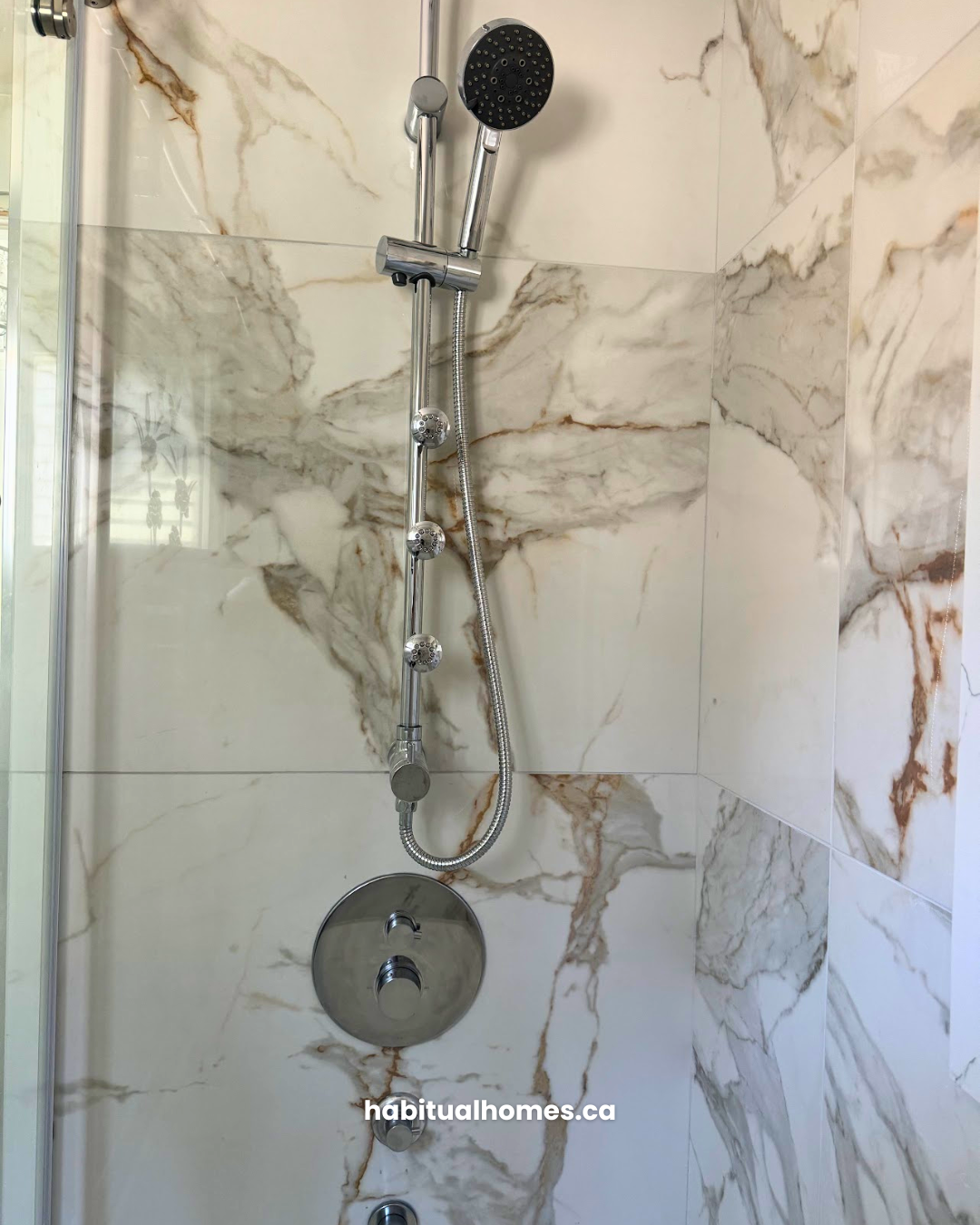
This natural variation is exactly why marble has been a hallmark of elegant kitchens and bathrooms for centuries. White Carrara marble, in particular, remains one of the most requested types of marble for kitchen islands and bathroom vanities because of its soft grey veining against a bright white background.
Durability and Heat Resistance
Quartz holds up well under everyday wear. Its engineered composition makes it highly resistant to chipping and scratching, which matters in a busy kitchen where cutting boards, pots, and utensils are constantly moving across the surface. That said, quartz is not fully heat resistant. The resins in the material can discolor or warp if a hot pan is set directly on the surface, so a trivet or cutting board is still the safer habit.
Marble is a harder, denser stone and handles intense heat better than quartz in short exposure, but it is more prone to chipping along edges and can scratch more easily than engineered stone. A dropped pot or a dragged cast iron pan is more likely to leave a mark on marble than on quartz.
Match the surface to how you actually cook. If your routine involves moving hot pans straight from the stove, searing, or running multiple sheet pans in and out of the oven, quartz will generally hold up better with less babying. If your counter is mostly used for plating and assembly after the cooking is done, either material can work well, and heat exposure becomes less of a factor in the decision.
| Scenario | Quartz | Marble |
|---|---|---|
| Hot pan straight from the stove | Risk of discoloration or warping | Generally safe for brief contact |
| Sheet pan from a hot oven | Use a trivet or cooling rack | Safe with a quick transfer |
| Cast iron cookware | Always use protection | Can scratch if dragged across the surface |
| Daily coffee pot or kettle | Safe on a trivet or mat | Safe for routine use |
Stains, Acids, and Everyday Use
This is where the two materials diverge the most. Quartz’s non-porous surface makes it naturally stain resistant. Spills from wine, coffee, or oil tend to sit on top of the surface rather than soaking in, and a quick wipe with mild soap and water is usually enough to keep it looking new.
Marble’s porous nature means it behaves very differently. Lemon juice, tomato sauce, vinegar, and other acidic substances can etch the surface, leaving a dull spot even after the stain itself is cleaned up. This is a chemical reaction between the acid and the calcium carbonate in the stone, not a cleaning issue, so it cannot always be wiped away. Home cooks who work with a lot of citrus, wine, or tomato-based sauces should weigh this carefully before choosing marble for a busy kitchen island.
| Ingredient | Quartz | Marble |
|---|---|---|
| Lemon juice and citrus | Wipes clean | Can etch the surface |
| Red wine and coffee | Very low risk | Can stain if not sealed |
| Tomato sauce and vinegar | Minimal risk | Prone to chemical etching |
| Cooking oil | Low risk | Low to moderate risk |
Maintenance: Regular Sealing vs Simple Cleaning
Quartz is widely considered a low maintenance option. Because the surface is non-porous, it does not require sealing, and proper care generally comes down to routine cleaning with mild soap and avoiding harsh abrasives.
Marble asks for more consistent attention. Regular sealing, typically once or twice a year depending on how the countertop is used, helps reduce how much liquid the stone absorbs and lowers the risk of staining and etching. Even with regular sealing, marble in a high-traffic area like a kitchen island will show its age over time, developing a soft patina that some homeowners love and others prefer to avoid.
| Maintenance task | Quartz | Marble |
|---|---|---|
| Sealing | Not required | Once or twice a year |
| Daily cleaning | Mild soap and water | pH-neutral stone cleaner |
| Deep cleaning | Rarely needed | Periodic professional service |
| Special products | None | Stone sealer and pH-neutral cleaner |
Look, Color, and Design Options
Quartz surfaces come in a wide range of colors, from solid neutrals to patterns engineered to mimic the look of natural stone. The consistency across slabs makes quartz a practical choice for large kitchens or open-concept spaces where matching multiple pieces matters.
Marble’s appeal comes from the opposite quality: no two slabs are the same. The unique veining patterns and natural look of real marble are difficult to replicate, which is why many homeowners choose marble specifically for a statement island or a feature wall, even if they use a more practical material elsewhere in the kitchen.
| Design factor | Quartz | Marble |
|---|---|---|
| Pattern consistency | Uniform across slabs | Every slab is unique |
| Color range | Wide, including bold colors | Limited to natural stone tones |
| Veining | Engineered and repeatable | Natural and unpredictable |
| Matching multiple pieces | Straightforward | Requires careful slab selection |
Lighting also changes how much of that veining you actually notice day to day. A showroom sample sits under lighting designed to flatter it, and your kitchen will not match that exactly. Marble’s veining tends to read softer under warm light and more pronounced under bright, cool light, while quartz patterns generally stay more consistent across different lighting conditions since they are engineered rather than natural. Before committing to a slab, it is worth bringing a sample home and looking at it near your actual counter space in the morning, in the evening, and under your kitchen’s regular lighting, since a pattern that looks striking in a showroom can read differently once it is installed.
Cost and Resale Value
Quartz and marble typically sit in different price brackets, and installation costs can vary depending on slab quality, edge profile, and the complexity of the layout. Rather than focusing on a specific number, it is worth having an honest conversation with your contractor about your budget, your daily habits in the kitchen, and how long you plan to stay in the home.
Both materials can support resale value when installed well, though buyer preference for natural stone versus engineered stone tends to shift with design trends and varies by neighborhood. In markets where buyers respond strongly to natural materials, a well-kept marble feature can be a selling point. In markets where buyers prioritize low-maintenance finishes, quartz tends to photograph and show consistently regardless of how the previous owners used the kitchen. Condition matters as much as material: a quartz or marble countertop that has been cared for well will support your listing far more than the specific stone you chose. A kitchen designer or renovation contractor familiar with your local market can offer a more grounded read on which material buyers in your area respond to.
Which Is the Right Choice for Your Kitchen?
There is no universal best choice between quartz and marble. The right countertop depends on your kitchen habits, your design preferences, and how much maintenance you are realistically willing to keep up with.
Quartz tends to be the better choice for busy, high-traffic kitchens where low maintenance and stain resistance matter more than one-of-a-kind veining. Marble tends to be the better choice for homeowners who want the natural beauty and unique character of real stone and are willing to commit to proper care, including regular sealing and a bit more caution around acidic liquids.
Some homeowners solve this entirely by mixing materials, choosing quartz for the main counters where daily cooking happens and reserving marble for an island, a bar area, or a bathroom vanity where the wear is lighter.
| Kitchen profile | Often a better fit | Why |
|---|---|---|
| Family with young children | Quartz | Spill resistant, low maintenance |
| Home cook who cooks daily | Quartz | Handles acidic ingredients and heavy use |
| Design-focused entertaining space | Marble, often on an island | Visual statement, lighter daily use |
| Mostly reheating and light prep | Either material | Comes down to aesthetic preference |
Frequently Asked Questions
Is quartz or marble better for a kitchen island?
It depends on how the island is used. If it doubles as a prep surface for acidic ingredients like citrus and tomatoes, quartz is generally the more forgiving choice. If the island is meant to be a design centerpiece with lighter daily use, marble’s natural veining can make a strong visual statement.
Can quartz look like real marble?
Many quartz manufacturers produce patterns designed to mimic the look of marble, including soft grey veining on a white background. The look is close, but the manufacturing process means the veining repeats in a way that natural marble never does.
Can etching on a marble countertop be repaired?
Minor etching can sometimes be buffed out by a professional stone restoration service, but deeper etches that penetrate the surface usually cannot be fully reversed. Prevention through quick cleanup of acidic spills and consistent use of cutting boards is more reliable than repair. Some homeowners come to see light etching as part of marble’s natural patina over time.
How do you know when a marble countertop needs to be resealed?
A simple water test is a reliable check. Place a few drops of water on the surface and wait several minutes. If the water darkens the stone or soaks in rather than beading up, the sealer has worn down and it is time to reseal. High-traffic areas like kitchen islands generally need resealing more often than a bathroom vanity.
Does the color of quartz affect how it handles heat?
Darker quartz colors can absorb more heat from sunlight or hot objects, which may make them slightly more prone to discoloration than lighter colors. Even so, the resin content and manufacturing process play a bigger role in heat resistance than color alone, and every quartz surface benefits from trivets and hot pads rather than direct contact with hot cookware.
Can quartz be installed outdoors or in a sunroom with a lot of direct sunlight?
Quartz is not generally recommended for outdoor installations or spaces with prolonged direct sun exposure, since the resins can yellow or fade over time. Natural stone tends to handle UV exposure better than engineered quartz. If your kitchen has large windows with strong afternoon sun on the counter, it is worth raising with your fabricator during material selection.
Is quartz more durable than marble overall?
Quartz generally resists scratching and staining better than marble, while marble handles brief exposure to intense heat slightly better than quartz. Quartz tends to keep its original look longer with less upkeep, while marble develops a patina over time that some homeowners want and others try to avoid. Overall durability comes down to how the countertop is used day to day.
A few things worth remembering:
quartz is engineered and non-porous, so it resists everyday stains without sealing, while marble’s porous structure makes it vulnerable to etching from acidic ingredients. Heat and scratch resistance run in opposite directions between the two materials, so match the surface to your actual cooking habits rather than the look alone. Maintenance commitment, not just appearance, should drive the decision, since marble asks for regular sealing and gentler cleaners while quartz does not. And mixing materials, quartz where the daily cooking happens and marble where the wear is lighter, is a practical way to get both durability and a design statement in the same kitchen.
Planning a Kitchen Renovation in Toronto?
Choosing between quartz and marble is easier when you can see and touch both materials in the context of your actual kitchen layout, lighting, and cabinetry. If you are planning a kitchen renovation and want guidance on which countertop material fits your space and your routine, our team at Habitual Homes can walk you through the options during a design consultation. Learn more about our kitchen renovation services in Toronto, or read our guide to choosing the right countertop edge profile once you have picked your material.