The sun sets earlier, the evenings get longer, and suddenly your living room feels a little less like the place you want to be. Most of the time the furniture is fine and the paint colour is fine. The problem is the light. A layered lighting living room feels warm and inviting at night, while a room lit from one spot on the ceiling feels flat, no matter how nice everything else is.
People want cozy spaces. The good news is that cozy is not a renovation. It is a plan.
The three things that make a living room feel cold
When we walk into a living room that feels cold at night, it is almost always one of these three.
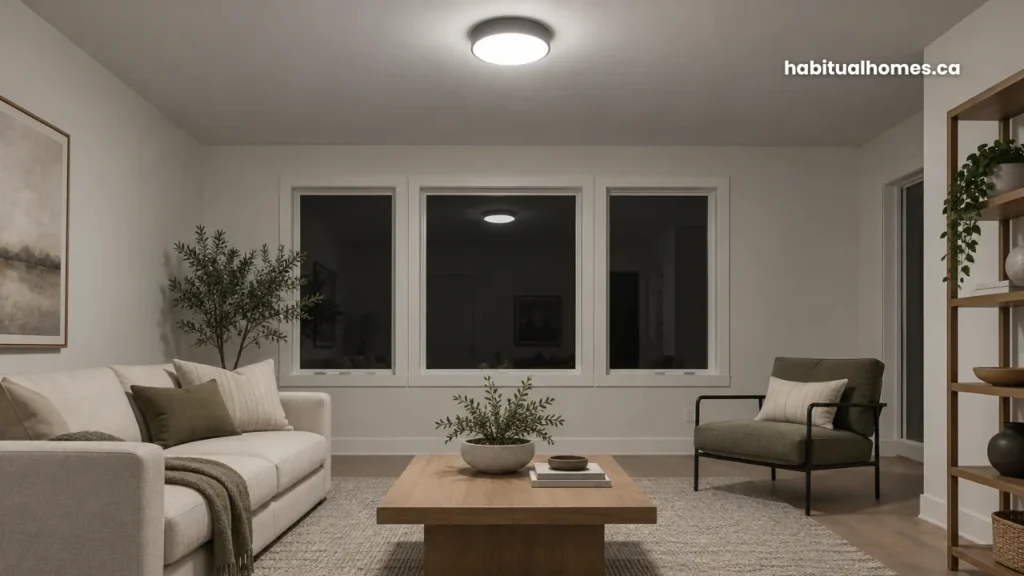
1. One lonely ceiling light
A single fixture in the middle of the ceiling throws light down and out from one point. Everything gets the same flat light, there is no glow at eye level, and the corners stay dull. It works for finding your keys. It does not work for an evening on the sofa.
2. Cool white bulbs
Bulbs are sold by colour temperature, measured in kelvin (K). The lower the number, the warmer and more yellow the light. Energy Trust of Oregon recommends around 2700K for living rooms and bedrooms, where you want a relaxing mood, and saves higher numbers like 3500K for kitchens and workspaces and around 5000K for reading and desk lamps. Put a 5000K bulb in a living room and it feels like an office or a waiting room, not a home.
3. A grid of potlights
Potlights are not the enemy. A neat grid of them, used as the only light in the room, is. Your ceiling starts to look like an airport runway: bright, even, and somehow still empty. All the light comes from above, so the room loses the soft pools of light that make a space feel lived in.
Light a room the way you dress for fall: in layers
Think about how you get dressed on a cold October day. You do not wear one giant coat and call it done. You wear a base layer, something for your hands, and a scarf that makes the whole outfit feel finished.
Lighting works the same way. The American Lighting Association describes three layers, and each one has its own job.
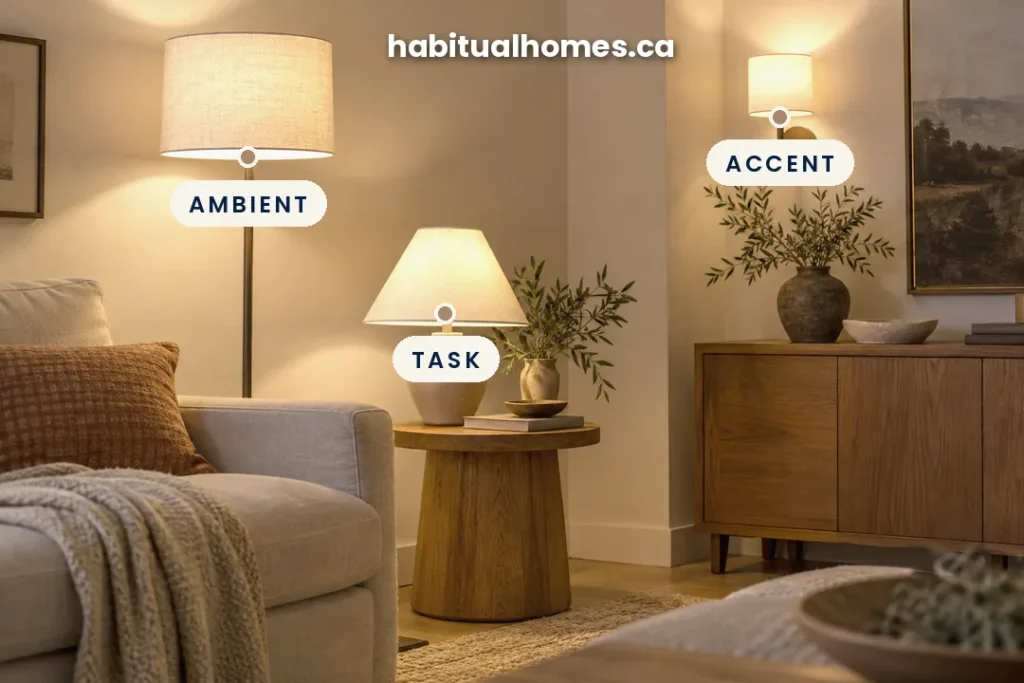
- Ambient light is the coat. It is the general light for the whole room. Ceiling fixtures, potlights or a large floor lamp usually handle it. It should be there, but it should not be the only thing on.
- Task light is the gloves. It is focused light for something specific: reading in a chair, working at a desk, playing a board game. A floor lamp next to the sofa or a table lamp by the armchair does this job.
- Accent light is the scarf. It is the cozy detail people notice: a sconce washing light down a wall, a glow under a shelf, a small lamp on a console. The ALA calls dimmers a must for this layer, and we agree. Being able to bring accent light down at night is what turns a bright room into a warm one.
A simple rule we use in our designs: in the evening, the light should come from several points at different heights, and most of it should sit at eye level or below, not only on the ceiling.
Planning a TV wall? Plan the lighting with it.
We design and build TV walls with the lamps, shelf lights and outlets planned from day one, so you never have to run cords across the room later.
SEE TV WALL DESIGNSThe TV wall is the best place to start
In most living rooms, the TV wall is the biggest surface in the room and the one you look at every evening. That makes it the perfect place to build in your accent and ambient layers, instead of adding them as an afterthought.
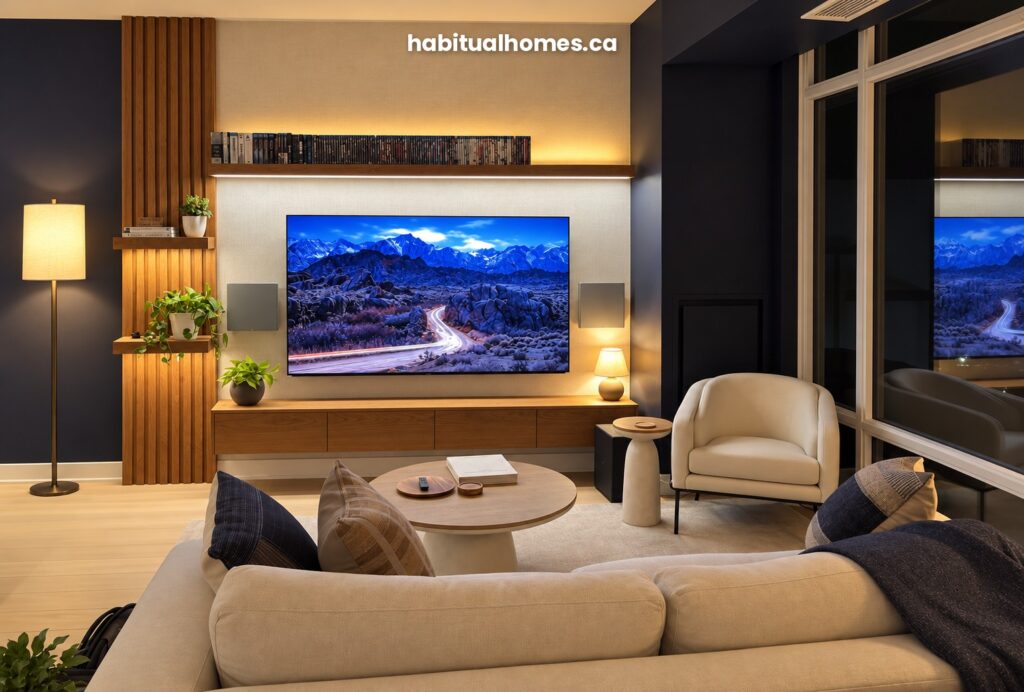
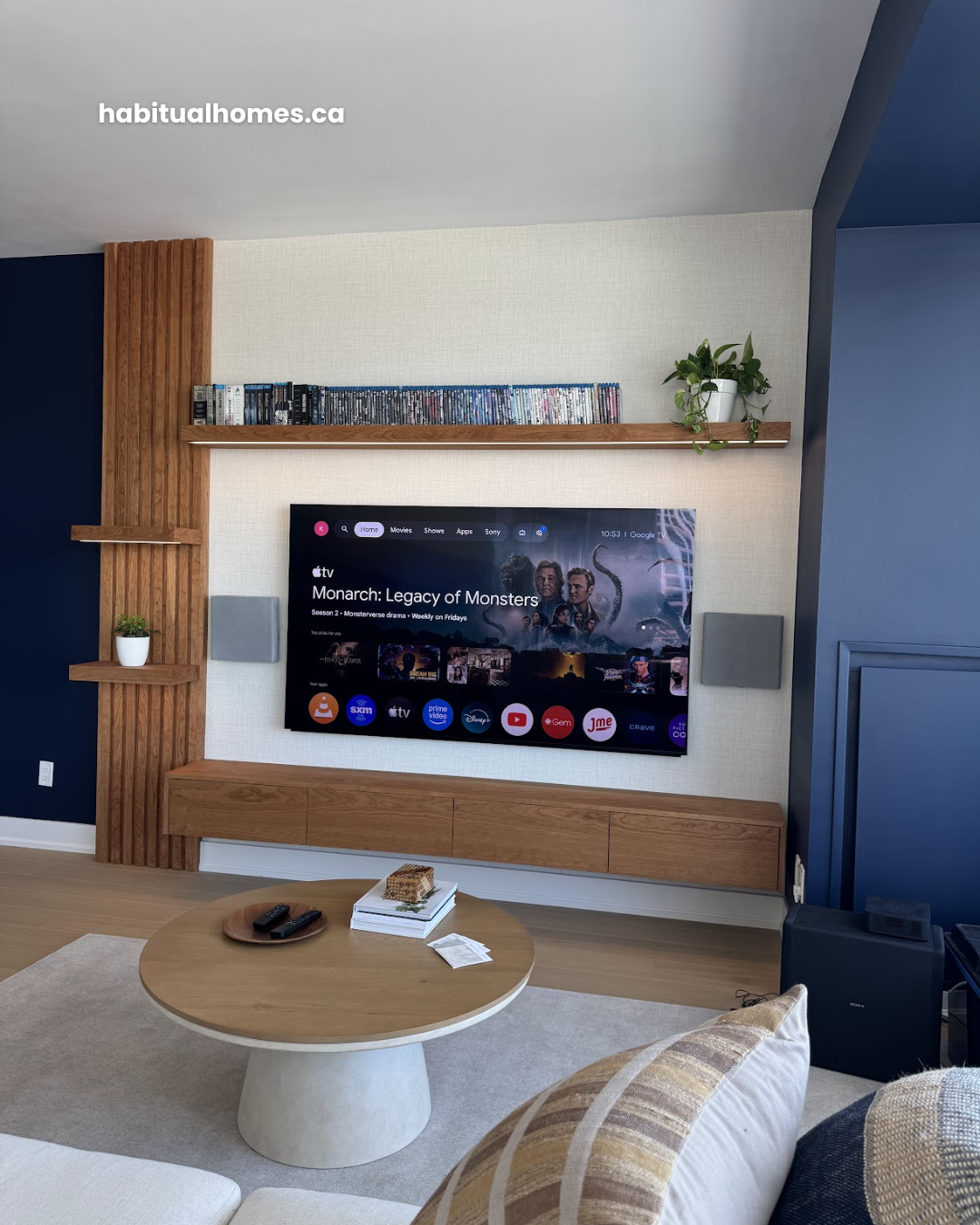
Here is how the layers work on a TV wall we designed for a Toronto condo:
- A warm glow under the floating shelf above the TV lights the wall softly and makes the whole unit feel lighter in the evening.
- A small table lamp on the console adds a low pool of light at eye level, right where you are looking.
- A floor lamp next to the slat panel fills in the corner so the room does not end in a dark edge.
None of these lights are bright on their own. Together, they make the room feel finished. If you are planning a media wall, decide where your lights go before the millwork is built. It is much easier to plan a channel for an LED strip, a hidden outlet for a lamp or a switch for a sconce now than to fix it after the wall is done.
For more ways to make the TV wall the warmest part of the room, see our media wall ideas for a cozy living room and our guide on where the TV wall should sit in the living room.
Don’t forget the paint
Light and paint work together. The same wall colour can look warm and creamy under a 2700K lamp and grey and flat under a cool bulb. If you have ever picked a paint colour that looked perfect in the store and wrong at home, lighting is often the reason. We explain this in the effect of lighting on paint colours, and if your walls are white or neutral, these tips on how to make whites and neutrals feel warm and cozy will help.
Quick checklist for a cozier living room this season
- Turn off the ceiling light one evening and see what is left. If the room goes dark, you need more layers.
- Check your bulbs. For the living room, look for warm white, around 2700K, on the box.
- Add at least one lamp at eye level near where you sit.
- Add one accent light: a sconce, a shelf light or a small lamp on a console.
- Put the accent layer on a dimmer.
- If you have potlights, use them for cleaning and bright tasks, not for relaxing.
FAQ
Do I have to remove my potlights to get a cozy living room?
No. Keep them as your ambient layer for when you need bright light, and add lamps and accent lights for the evening. A dimmer on the potlights also helps a lot.
What colour temperature should my living room bulbs be?
For a relaxing room, look for warm white bulbs around 2700K. Energy Trust of Oregon recommends this range for living rooms and bedrooms. Keep cooler bulbs for kitchens, workspaces and reading lights.
My living room has no ceiling light at all. Is that a problem?
Not necessarily. Many cozy living rooms run entirely on lamps and wall lights. You just need enough light sources so the room does not feel dark when you need to clean or find something.
Can lighting be built into a TV wall?
Yes, and it is the best time to plan it. LED strips under shelves, outlets hidden behind the console for lamps, and wiring for sconces are all easier to include during the design than to add later.
I rent, so I can’t change the wiring. What can I do?
Plug-in lamps do most of the work. Swap the bulbs to warm white, add a floor lamp and a table lamp, and use a plug-in sconce or a battery shelf light for the accent layer.
Ready for a living room that feels warm every evening?
If you are planning a TV wall or a living room update, we can design the lighting together with the millwork, so everything has its place from the start.
Sources
- Energy Trust of Oregon, Color matters: choosing light bulbs: https://insider.energytrust.org/color-matters-choosing-light-bulbs/
- American Lighting Association, Get the Right Light: https://alalighting.com/Blog/ArtMID/623/ArticleID/701/Get-the-Right-Light