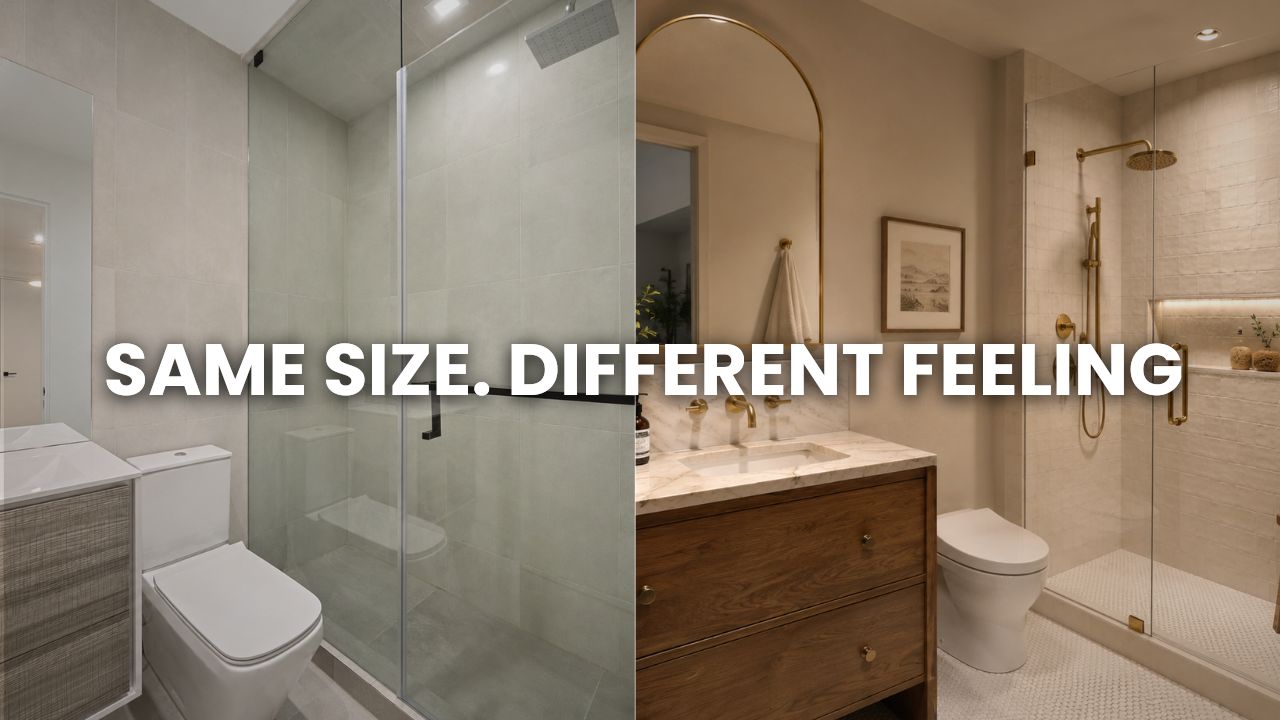
Most bathrooms that don’t feel relaxing have the same problem. It’s not the size. It’s not the missing freestanding tub. It’s that every surface in the room is hard, flat, and cold — and the light makes it worse. The result is a space that looks finished on paper and feels like a clinic in person. That gap between what a bathroom costs and how it feels is almost never about the budget. It’s about three specific decisions most people don’t know to make until after the walls are closed.
This video is about those three decisions. They’re not trends and they’re not expensive. They’re the choices that determine how your bathroom feels for the next 15 years — and they happen to be the same choices that make a bathroom age well. If you’d rather watch than read, the video is right below.
Why most renovated bathrooms feel like clinics
Spend enough time in bathrooms that technically work but don’t feel right, and a pattern shows up. Tile floor, tile walls, glass shower, porcelain counter. Every surface is hard and reflective. The light is cool and overhead. There’s nothing in the room that absorbs sound, softens the light, or gives your eyes somewhere to rest.
That’s what we call the sensory temperature of a space. It’s the combined effect of your lighting, your materials, and your textures. When all three run cold and hard, the bathroom feels clinical no matter how much went into it. The fix isn’t a bigger renovation. It’s understanding which decisions control that temperature and making them deliberately.
Decision 1 — Light: color temperature and fixture position
Two things determine whether your bathroom light works against you.
The first is color temperature. Most bathrooms are lit at 4,000K — office light. The number that makes a bathroom feel warm and calm is between 2,700K and 3,000K. It’s printed on the bulb package. It’s one of the lowest-cost decisions in a renovation and one of the most impactful. Swapping bulbs changes the entire character of the room without touching a single surface.
The second is position. A single overhead fixture creates shadows under your eyes and across your face. It’s not flattering and it doesn’t feel relaxing. What works better — especially in a small Toronto bathroom where you can’t always fit two fixtures — is one pendant or one sconce on the side of the mirror, roughly at face height. Even a single fixture in the right position changes the entire experience of that vanity wall.
The tradeoff: fixture position is an electrical decision. It has to be planned before the walls close. If you’re in the middle of a renovation and this hasn’t come up yet, bring it up now. After close-in it becomes a much bigger conversation.
Decision 2 — Material warmth: four surfaces that control how a bathroom feels
This is the decision that determines how your bathroom reads for the next 15 years.
The vanity. It’s the piece you interact with every single day — where you start your morning and end your night. If it reads cold, the whole experience reads cold. The material that works consistently in a warm bathroom is wood-tone: white oak, walnut, or a rated front in a matte finish. Not painted, not gloss. That warm tone anchors the entire palette. The honest tradeoff: a new vanity means plumbing installation and probably a new countertop. It’s a real renovation decision, not a cosmetic one. But warm wood doesn’t date the way trends do, which makes it one of the more durable investments in the room.
The mirror. The mirror wall is where most bathrooms look unfinished — not because the mirror is wrong but because nothing anchors it. A framed mirror changes that. The shape matters less than having a thin frame in warm wood or brushed metal that gives the wall some weight.
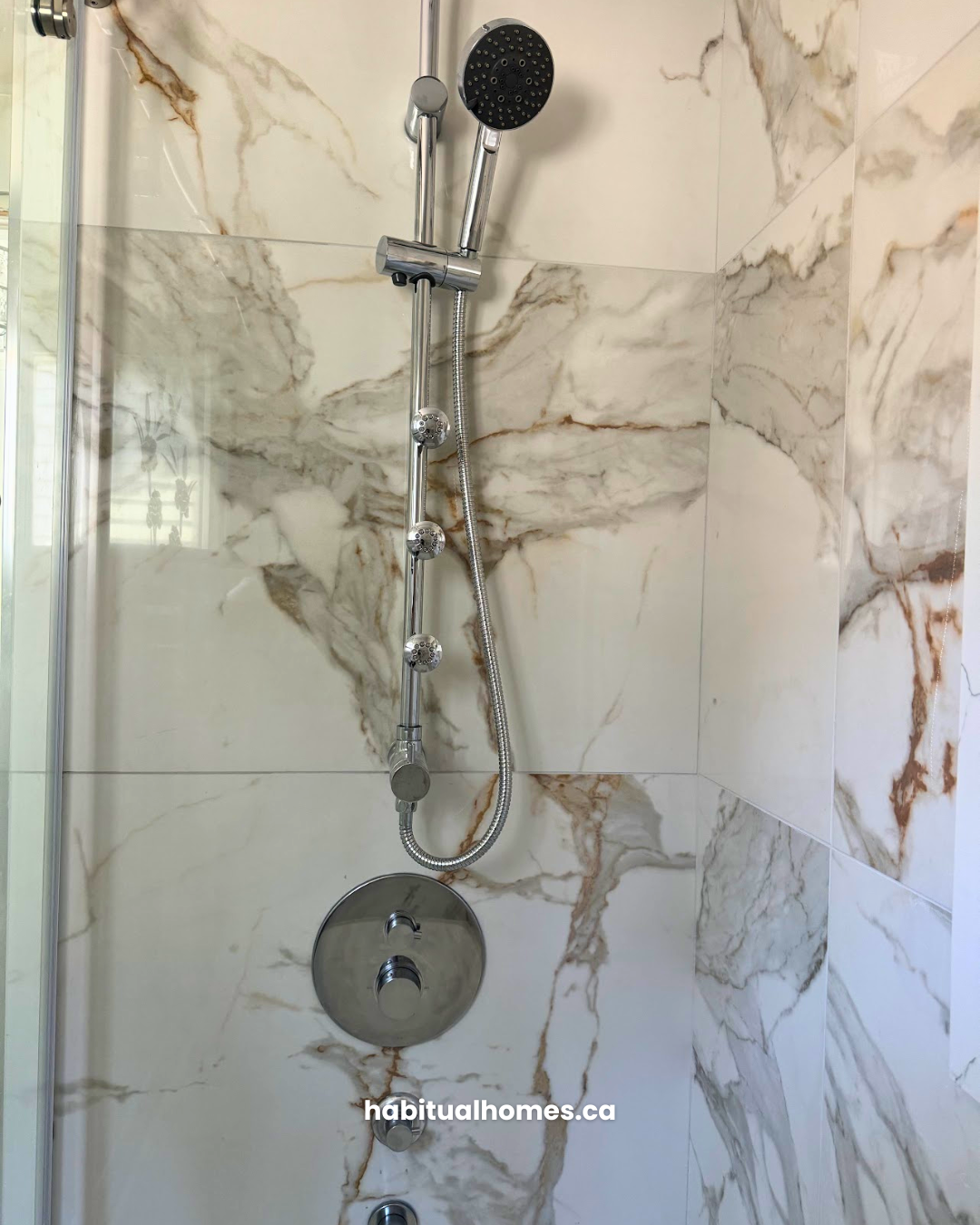
The tile. This is where the most time gets spent and where the most regret happens. The bathrooms that age best have tile with slight texture and variation — something that doesn’t look perfectly machine-made. Not because it’s a specific material or a current trend, but because slight imperfection reads as craft, and craft doesn’t date. The mistake that shows up most often is the opposite: tile that’s perfectly flat, perfectly uniform, perfectly on-trend right now. In five years, that perfection is exactly what makes it feel frozen. The question isn’t whether a tile is timeless. The question is whether it has enough character to age — or whether it’s just current.
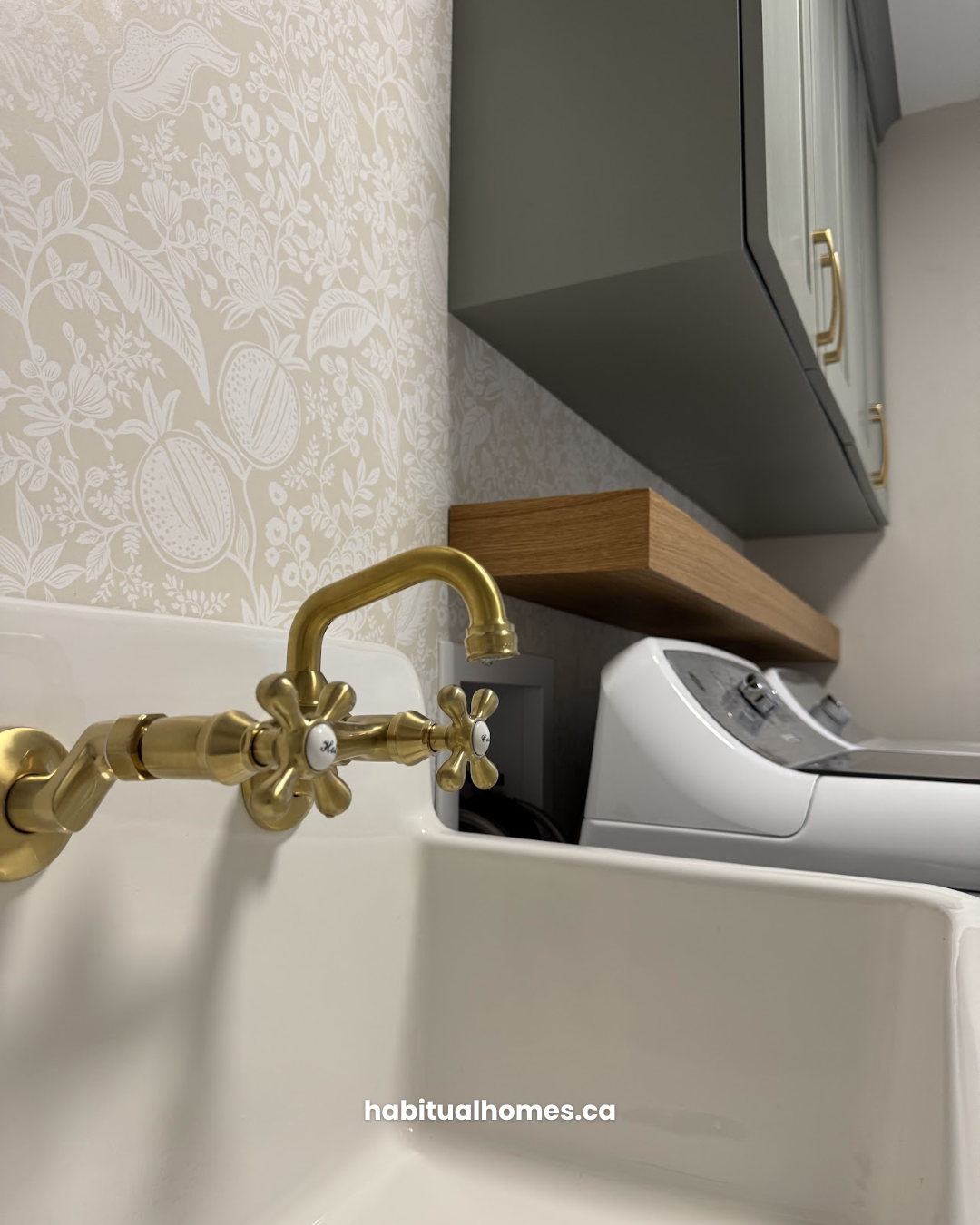
The hardware. The most reversible decision in a bathroom renovation. Brushed or aged brass works in a warm palette. Not shiny gold — brushed or aged. The principle is simple: brass belongs in a warm room. If the rest of the space is still running cold, brass reads as decoration, not decision.
Decision 3 — Texture: the layer most renovations skip entirely
Look at a typical renovated bathroom. Tile floor, tile walls, glass shower, porcelain counter. Every surface is hard, flat, and reflective. There’s nothing that absorbs sound or softens light. That’s why it echoes. That’s why it feels cold even when the finishes are technically good.
Three additions change this — and none of them require touching the renovation itself.
A wood shower stool or bench. Teak handles moisture without rotting and brings an organic material into the wettest part of the room. It makes the shower feel considered instead of just functional.
A bath mat or washable runner in a warm neutral — warm beige, stone, soft taupe. The mat breaks up hard tile and adds the first soft surface in the room. This alone changes how the floor reads.
Towels, a tray, a plant if there’s enough light. Thick white towels, a small wood tray on the counter. These aren’t styling tricks — they’re texture layers. They absorb light instead of bouncing it. Together these three things cost almost nothing compared to the renovation itself, and they do something the renovation alone can’t: they make the bathroom feel like a room you chose to be in.
When the spa bathroom approach is NOT what you need
This framework — warm light, wood-tone vanity, textured tile, layered texture — works in most primary bathrooms and main bathrooms in Toronto homes. It doesn’t apply everywhere.
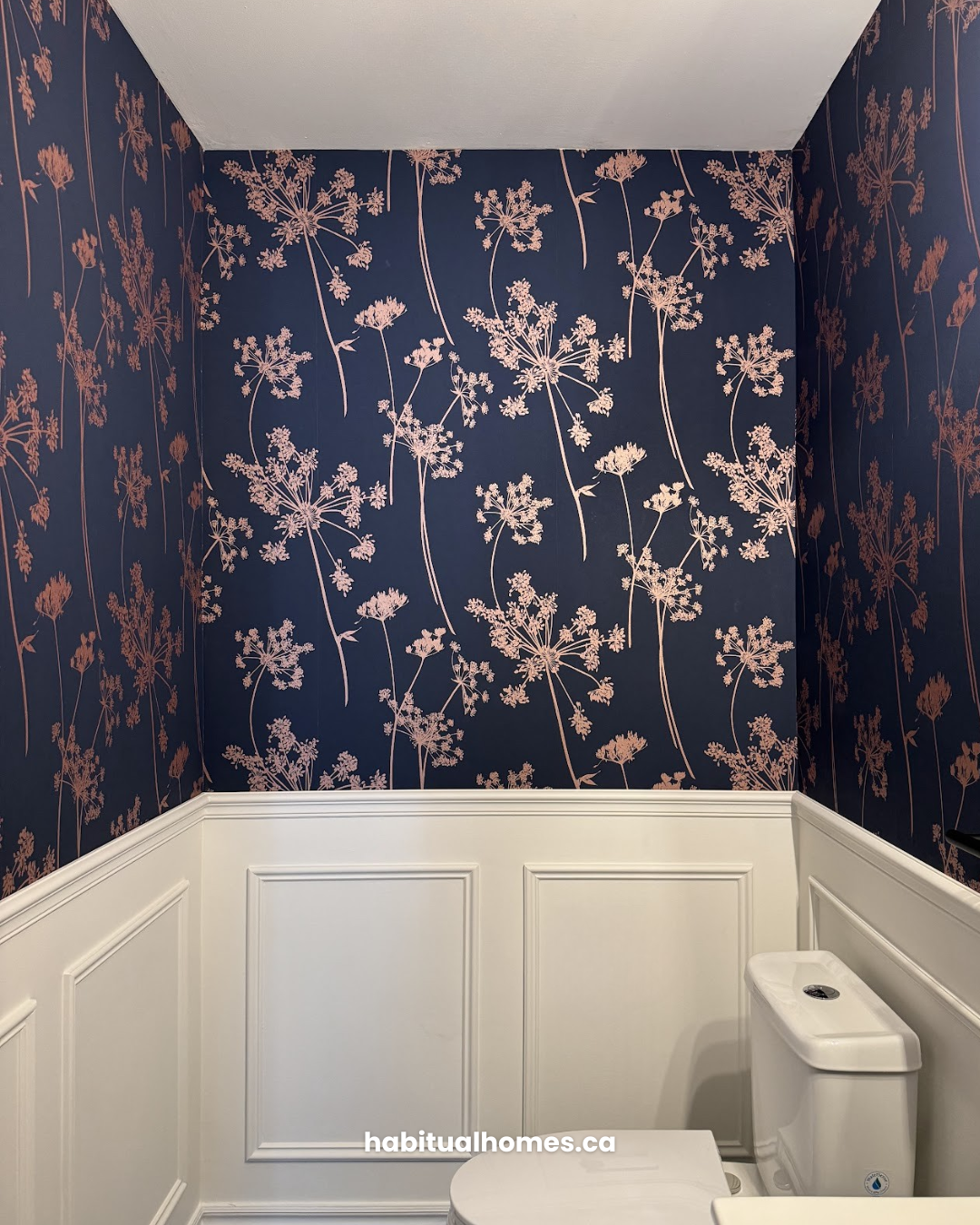
In a powder room used primarily by guests, high-contrast or graphic tile can work well because the room is rarely occupied long enough for sensory temperature to register. In a rental property or investment unit, the durability and cost of warm materials has to be weighed against tenant turnover — sometimes a clean, neutral, clinical finish is the right call. If the bathroom gets heavy natural light all day, the warming work is already half done and you have more flexibility with cooler materials. And if the client genuinely prefers a crisp, white, minimal aesthetic, chasing warmth in a room that’s meant to feel minimal will produce something that reads muddled rather than calm.
FAQs about spa bathroom renovations in Toronto
Do I need a freestanding tub to make a bathroom feel like a spa?
No. A freestanding tub is a nice feature if the room has the space and the budget, but it doesn’t address the underlying reason most bathrooms don’t feel relaxing. A bathroom with a warm-toned vanity, the right light temperature, and layered texture will feel calmer than a bathroom with a freestanding tub dropped into an otherwise cold, clinical space.
What light bulb Kelvin is best for a spa bathroom?
Between 2,700K and 3,000K. This range produces warm white light — the opposite of the 4,000K cool white bulbs most bathrooms are lit with. The Kelvin rating is printed on every bulb package. It’s one of the lowest-cost changes in any bathroom renovation.
Is warm wood in a bathroom practical for Toronto homes?
Yes, with the right finish and installation. Matte-finish wood-look vanities perform well in bathrooms with normal humidity. Solid wood near moisture sources needs proper sealing and ventilation. Teak and similarly dense woods are well-suited to wet environments like shower benches. Most of the failures we see aren’t a material problem — they’re a ventilation problem.
How do I add texture to a bathroom without redoing the renovation?
Start with a bath mat in a warm neutral, a wood tray on the counter, and thick towels. These three alone change how the room feels because they introduce the first soft, light-absorbing surfaces into a space that’s otherwise all hard and reflective. A wood stool in the shower, a framed mirror, and a plant if there’s enough light complete the layer.
What tile ages best in a Toronto bathroom renovation?
Tile with slight texture and visible variation — something that doesn’t look perfectly machine-made. Not because it’s a specific material, but because slight imperfection reads as craft, and craft doesn’t date. The tiles that tend to show the most regret are the ones that are perfectly flat, perfectly uniform, and perfectly on-trend at the time of install. In five years, that precision is what dates them.
Planning a bathroom renovation in Toronto?
The decisions that make a bathroom feel like a spa are the same decisions that make it age well — and most of them happen before demo, not after. Light placement, vanity selection, tile character. Getting those right on paper is less expensive than fixing them on site.
Look through our work at habitualhomes.ca/bathroom-renovation-toronto/, and reach out when you’re ready to start the conversation about your bathroom.
Related articles