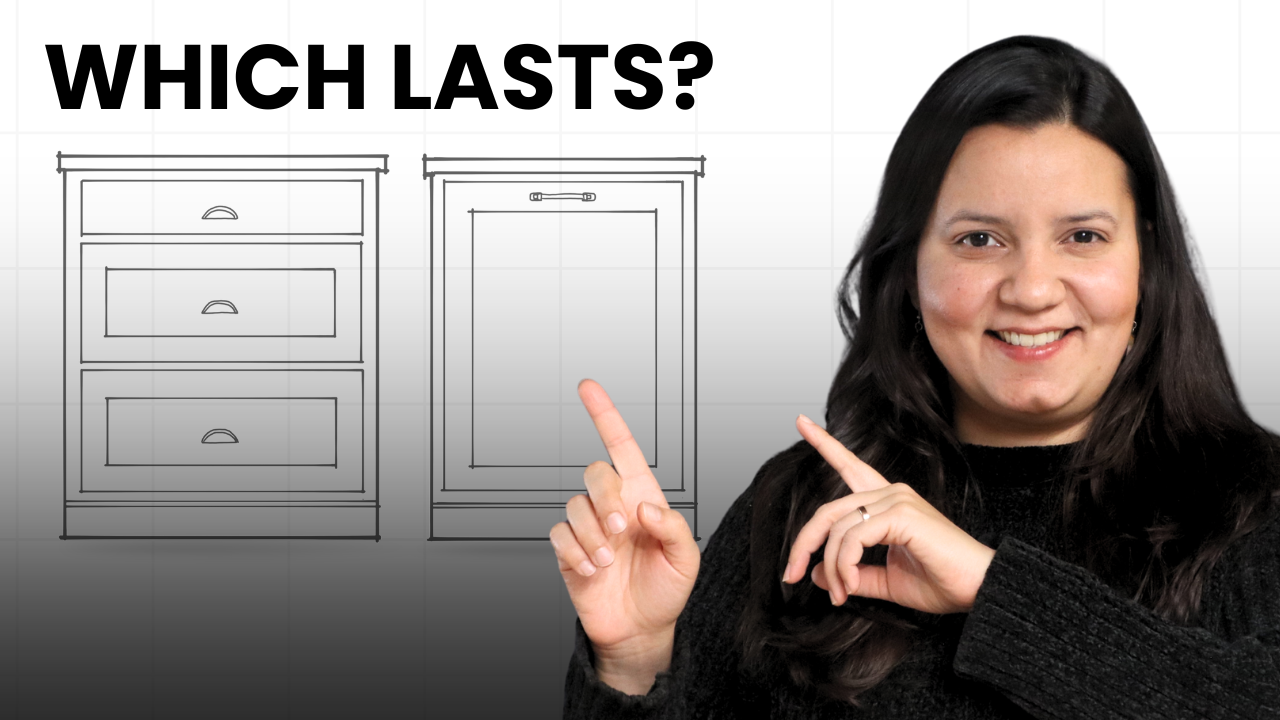
Drawers or doors on lower cabinets is one of the first real decisions you make in any kitchen renovation, and it shapes how the room works every single day. The choice sounds small, but it changes how you reach your pots, where your everyday items live, and how much usable storage space you actually get out of your base cabinets. In the video below we walk through how we think about this when we design and build kitchens in Toronto, and this guide breaks down the same thinking so you can decide what fits your own kitchen.
Why the Lower Cabinet Debate Matters
Most of your kitchen storage lives below the counter. The lower cabinets carry the weight of daily cooking, while the upper cabinets handle lighter, less frequent items. For decades, base cabinets came with a single door and one fixed shelf inside. That setup looks fine, but it sends half of your storage to the back of the cabinet, where you end up kneeling and digging to find a lid or a pot you put away last week. When you rethink the lower cabinets, you are really rethinking how the whole kitchen feels to use.
The Case for Drawers on Base Cabinets
Deep drawers solve the biggest problem with traditional lower cabinets: access. A drawer base cabinet pulls everything out to you instead of asking you to reach in. With full extension drawer slides, the entire drawer clears the cabinet, so nothing hides at the back and you get quick access to every item in one motion.
A bank of drawers also stores more than you expect. Wide drawers and deep drawers hold a large pot, Dutch ovens, and heavy items at a height that is easy on your back. Stack a few drawer banks together and you can keep pots in one, lids in another, and small appliances in a third, all visible the second you pull them open. That is better storage in the same footprint, and it is why we put base cabinet drawers in the prep and range zones of almost every kitchen we design.
The hardware matters as much as the layout. Quality drawer slides with soft-close or self closing action keep heavy drawers from slamming, even when they are loaded with cast iron. Soft-close hardware is one of those small details that you notice every day once you have it.
When Doors Still Make Sense
Drawers are not the answer for everything. Cabinet doors still earn their place in a well planned kitchen.
Tall items and large appliances are the clearest example. A stand mixer, sheet pans stored upright, or a tall stock pot fit better behind a single door than inside a set of drawers. Cabinets with shelves give you vertical room, and adjustable shelf pins let you change the cabinet size of each shelf to match what you store. Corner cabinets are another case, since a door paired with pull-out shelves or roll-out shelves reaches the dead space far better than a drawer can.
There is also a cost difference. Cabinet doors are simpler to build than a stack of drawer boxes and slides, so an all-drawer kitchen carries a higher cost than the same run of regular cabinets. For many homeowners, doors in the right spots are a smart way to control the budget without giving up function. Upper cabinets, for what it is worth, almost always keep their doors.
The Smart Answer Is Usually a Mix
In practice, the best kitchens rarely pick one or the other. A mix of drawers and doors lets each part of the kitchen do what it does best. We tend to put deep drawers near the stove and prep area for everyday items, doors where tall or seasonal things live, and pull-out shelves inside a few of the door cabinets so you still get easy access without the full cost of drawers everywhere. A kitchen island is a great place for a wide bank of drawers, since you reach it from the open side with nothing in the way.
This is a kitchen design decision, not a rule. The right balance depends on how you cook, what you own, and how your storage needs are spread across the room. That is the conversation we have with every client before a single new cabinet is ordered.
What Makes a Drawer Worth the Money
If you decide drawers are right for your kitchen, the build quality is what separates a custom result from regular cabinets. A few things to look for:
- Drawer boxes: Look for a solid plywood core with dovetail or doweled joints, not stapled particle board. We use solid material where it shows and plywood where it works hard.
- Drawer slides: Full-extension, soft-close slides from a brand like Blum Tandem carry heavy loads smoothly for years.
- Drawer fronts and finishes: Fronts should match your cabinet doors exactly, with finished end panels so exposed cabinet sides never show construction holes.
- Inside the box: A vertical divider for trays or a peg system keeps a big drawer organized instead of becoming a deep pile.
These are the same customization options that make a kitchen feel built for you. If you want to go deeper, our guide on the details that make cabinets look custom covers the finishing touches, and our piece on cabinet choices that stay timeless helps you choose fronts you will still like in ten years.
Planning Drawers or Doors in Your Toronto Kitchen
As a design-build team, we plan storage around how you actually cook, then design, build, and install the cabinets so the result matches the drawings. Whether you lean toward an all-drawer base or a balanced mix, the goal is a kitchen that is easier to use the day you move back in. If you are starting to map out a renovation, our approach to kitchen design in Toronto walks through how we turn your storage needs into a working layout, and you can also read whether it makes sense to extend your cabinets to the ceiling while you are at it.
Frequently Asked Questions
Are drawers better than doors for lower cabinets?
For most everyday cooking, yes. Deep drawers bring items out to you instead of sending them to the back of the cabinet, so you get easier access and use more of the space. Doors are still better for tall items, large appliances, and corner cabinets, which is why most kitchens use a mix.
Do drawers cost more than cabinet doors?
Generally, yes. Each drawer needs a drawer box and a pair of quality slides, so a full bank of drawers carries a higher cost than a single door with a shelf. The payoff is daily function and storage. Many homeowners place drawers where they cook most and keep doors elsewhere to balance the budget.
Can you put drawers in a corner cabinet?
Corners are tricky because the angle wastes space behind the front. A standard drawer cannot reach back into the corner, so most kitchens use a door with pull-out shelves, roll-out shelves, or a specialty corner system instead. A good designer maps the corner early so that dead space is kept to a minimum.
What should I store in deep drawers versus doors?
Use deep drawers for pots, lids, a large pot, Dutch ovens, and heavy everyday items near the range. Keep doors for tall or seasonal things like sheet pans, a stand mixer, and large appliances. This mix gives you quick access where it counts and vertical room where you need it.
Thinking about new cabinets for your kitchen? We design and build the whole project, so you only ever talk to us. Book a consultation and we will help you decide where drawers and doors make the most sense for the way you live.