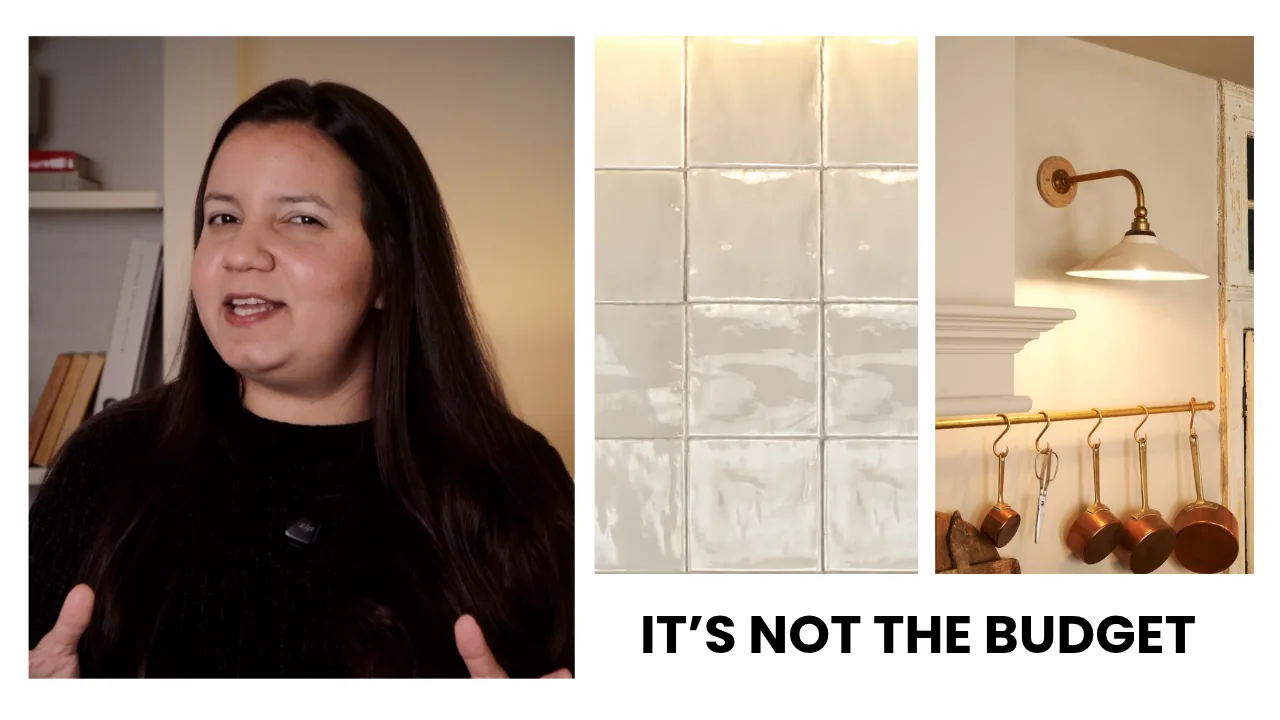
If you want to make your kitchen look expensive, the first thing to know is that the budget isn’t what decides it. Two kitchens can cost the same and look completely different. One looks designed. The other looks like it came out of a box.
The difference is three decisions, made before you buy a single cabinet: the fit, what stays, and how it feels. I walk through all three in this video, and below you’ll find the same ideas written out, with links to go deeper on each one.
The fit: what gives away a catalogue kitchen
A designer can tell in two seconds when a kitchen was put together from a catalogue. These are the giveaways.
Filler strips in every corner
Ready-made cabinets come in fixed sizes. Your walls don’t. So the space that’s left over gets covered with a strip of wood. One small filler is normal. When you see them in every corner, the kitchen looks filled in, not designed.
Lines that don’t line up
Look at the top of the upper cabinets, the top of the window and the hood. When each one stops at a different height, you feel it, even if you can’t say why.
Things that are almost centred
A sink a little off the window. A hood a little off its wall. It usually happens because a cabinet size didn’t fit, so something had to move. Almost centred is harder on the eye than not centred at all.
Doors of every size
A skinny door here, a wide one there. When the widths change without a reason, the doors stop having a rhythm, and the whole wall looks busy.
The details that make cabinets look like furniture
Then there are the details. A door that sits inside the frame instead of on top of it. A crown at the top that’s sized for the room. A base that looks like a piece of furniture instead of a dark gap at your feet. They’re small things, but they’re what make cabinets look like furniture instead of boxes. I go through them one by one in 5 details that make cabinets look custom.
Trim size matters more than most people think. A taller ceiling asks for a bigger crown and a taller baseboard, and a lower ceiling asks for less. The classical way to size them is to divide the wall like a column, which is how traditional trim gets its proportions. If you’re deciding on crown right now, read crown molding for kitchen cabinets before you order.
It’s not the fabric, it’s the fit
Think of a jacket. A simple jacket that fits you well looks better than an expensive one that doesn’t. It’s not the fabric. It’s the fit. In a kitchen, the fit is proportion.
That’s the real value of a kitchen designer. It isn’t picking pretty things. It’s looking at your walls, your window and your plumbing, and deciding where everything goes so it all lines up. With custom cabinets, every box is drawn for your wall, so there’s nothing left over to hide. With ready-made cabinets, a good layout can still hide most of it. But someone has to see it before it’s built.
And the kitchen has to fit the house, not just the room. In an older Toronto home, a kitchen that respects the trim, the windows and the ceiling looks like it was always there. One that ignores them looks dropped in, and dropped in never looks expensive.
Planning your kitchen and want someone to make these calls with you?
See the Kitchen Design PlanWhat stays: what’s in the store isn’t your house
Here’s what usually happens. It’s time to do your kitchen, so you look for ideas. Everywhere you look, you see the same kitchen. Then you go to the stores, and they sell that same kitchen. Same doors, same counter, same wood. So that’s what gets installed.
It’s not your fault. Stores sell what’s popular right now. But popular right now doesn’t mean it looks good in your house.
Why a trend starts to feel like your taste
There’s a reason the kitchen in your feed starts to feel like your own taste. The more often we see something, the more we tend to like it. Psychologists call it the mere exposure effect (Zajonc, 1968). Your feed shows you the same kitchen again and again, until it feels like yours.
Wood is where it goes wrong the most
Every wood has a colour underneath. Some lean orange, some yellow, some pink, some grey. Put a cabinet wood next to a floor that leans the other way, and they fight. If you’re keeping your floor, read should kitchen cabinets match the floor? before you choose a finish.
The wood tone everyone wants today is usually the first one to look dated. Remember the orange oak kitchens of the nineties? Everyone loved those too. If you’re choosing wood or a cabinet finish now, these are 5 kitchen cabinet choices that won’t look dated in 10 years.
Start with what stays
A designer doesn’t start in the store. A designer starts with what stays: the floor running in from the hallway, the windows, the trim, the stone you’re keeping. Those set the rules, and everything new has to get along with them. If you want to see how that works with colours and finishes, read how to choose kitchen colors that go together.
Skip this step and the new kitchen can make the rest of your house look tired. Psychologists have a name for that too: the Diderot effect, where one new thing makes everything around it look old (McCracken, 1988). Suddenly you want to redo the dining room as well.
My rule: where to spend
Put your money in what’s hard to change. Keep the trends in what’s easy to change.
| Hard to change: invest here | Easy to change: follow the trend here |
|---|---|
| Cabinets | Lamps and pendants |
| Countertops | Stools |
| Wood and floors | Paint colour |
How it feels: lighting, real materials and storage
The third decision isn’t about how the kitchen looks. It’s about how it feels to be in it every day.
Light in layers
One light in the ceiling lights everything the same. It’s like a photo taken with the flash on: flat. A designed kitchen has layers. A soft light for the room, task lighting right where you work, and a little accent light that shows off something you love.
Run a light down a backsplash with some texture, like handmade tile, and every edge catches the light. Same tile, much richer wall. Lighting has to be in the plan from the start, because the wires go in before the walls close. If your kitchen gets little daylight, this guide helps: how to make a dark kitchen feel brighter.
Real materials
The grain in real wood and the veins in stone give your eye something to rest on. Studies on wood indoors find that people often describe rooms with visible wood as warmer and more comfortable (Burnard and Kutnar, 2015). You don’t need it everywhere. A wood island, a few shelves or a counter with some movement is enough.
A place for everything
In one study, people who described their homes as cluttered had stress patterns that didn’t calm down during the day the way they should (Saxbe and Repetti, 2010). A calm kitchen isn’t one where you tidy more. It’s one where the toaster, the oils and the chargers already have a place. That’s storage planned for how you live, before the cabinets are ordered. Here’s how to plan kitchen storage before cabinets.
My honest take on cost
Expensive-looking doesn’t mean cheap to build. Custom cabinets cost more than ready-made. Good lighting costs more than one ceiling light. That’s the trade-off.
But the fit, what stays, the light and the storage cost very little when they’re decided in a drawing. They cost a lot when they’re fixed after the cabinets arrive. It’s like the jacket again: getting it fitted before you wear it is easy. Fixing it after is not.
FAQ
Do I need custom cabinets to make my kitchen look expensive?
No. Custom cabinets make it easier, because every box is drawn for your wall and there’s nothing left over to hide. But a good layout can make ready-made cabinets look much better: fewer fillers, lines that line up, doors with a rhythm and trim sized for the room. What you can’t skip is the planning.
Can a ready-made or IKEA kitchen look expensive?
It can look a lot more expensive than it is when the layout is designed around your walls instead of around standard sizes. The boxes matter less than how they’re arranged, how they meet the ceiling and the floor, and what you put on the outside, like doors, panels, trim and hardware.
What should I change first if my kitchen looks cheap?
Start with what bothers your eye the most and costs the least to fix. Often that’s lighting: one ceiling light makes everything look flat. Then look at clutter on the counters and at small trim details. Cabinets, counters and wood come last, because they’re the hardest to change and they set the rules for everything else.
Is it better to follow trends or go timeless?
Both, in the right places. Keep the trends in what’s easy to change, like lamps, stools and paint. Keep what’s hard to change, like cabinets, countertops and wood, in line with your house so it doesn’t date as fast.
Want the hard calls made before anything is built?
That’s what a kitchen designer really does. Not picking pretty things, but judging what fits your house and making the hard decisions while they’re still cheap, in a drawing.